

When it comes to securing heavy cargo — whether on a flatbed, in a shipping container, or across a job site — the decision between sourcing from a professional load binder supplier and assembling DIY tie-down solutions has real consequences for safety, compliance, and operational efficiency. As of 2026, cargo securement regulations in North America and Europe continue to tighten, and the gap between a properly rated, supplier-sourced load binder and a field-assembled alternative is wider than many operators assume. This page breaks down the key differences across specifications, working load limits, hardware durability, and total cost of ownership — so you can make an informed decision for your fleet, warehouse, or logistics operation.
The Problem with DIY Tie-Down Builds
Why DIY Tie-Down Solutions Fall Short in Professional Settings
DIY cargo securement typically involves sourcing webbing, buckles, and hooks separately from general hardware suppliers and assembling them on-site or in a workshop. While this approach can seem cost-effective upfront, it introduces critical gaps in traceability, rated capacity, and hardware compatibility.
Core Risk Factors
- No unified WLL (Working Load Limit): A DIY assembly's rating is only as strong as its weakest component. Mixing a 3,333 lbs ratchet buckle with a hook rated at 2,000 lbs produces a system rated at the lower figure — but without clear labeling, operators often assume the higher value.
- Inconsistent webbing quality: Generic polypropylene or low-density polyester webbing can exhibit creep under sustained load, reducing effective tension by up to 30% over a long haul.
- No certification path: DOT and EN 12195-2 compliance requires the assembly — not just individual parts — to be tested and rated. DIY builds cannot carry a legitimate system certification.
- Hardware mismatch: Forged hooks, buckles, and anchor points from different manufacturers may have incompatible throat widths or load geometries, creating stress concentrations at connection points.
Comparison: DIY Assembly vs. Supplier-Sourced System
| Factor | DIY Assembly | Supplier-Sourced Load Binder |
| System WLL traceability | Estimated / unverified | Documented per assembly |
| Hardware compatibility | Variable | Matched and tested |
| Certification | Not available | WSTDA / ISO 9001 where applicable |
| Failure point visibility | Low | High (rated at each component) |
| Replacement part sourcing | Inconsistent | Standardized SKUs |
For operations running more than 10 loads per week, the administrative and liability cost of managing DIY builds quickly outweighs any savings on initial procurement.
What a Professional Load Binder Supplier Provides
Supplier-Grade Load Binders: Specifications That Matter
A professional load binder supplier delivers assemblies and components that are rated, traceable, and built to perform under real working conditions. Our Industrial Steel Load Binder is a direct example of what that means in practice.
Industrial Steel Load Binder — Key Specs
- Material: Heat-treated steel for consistent tensile performance
- Capacity range: 10 Ton to 25 Ton working load
- Safety factor: 3:1 (meaning a 10-ton WLL unit is proof-tested to 30 tons)
- Style: Lever type with hook and handle configuration
- Finish options: Yellow paint or zinc plated for corrosion resistance
- Application: Flatbed trucking, rail, heavy machinery transport
How Supplier Sourcing Changes the Risk Profile
Every unit we ship carries documented WLL, finish specification, and dimensional data. Unlike a field-assembled alternative, a supplier-sourced binder allows fleet managers to:
- Match hardware to chain or strap grade without calculation errors
- Replace components with identical-spec parts, not nearest-available substitutes
- Demonstrate compliance during roadside inspections or insurance audits
For wholesale buyers placing orders of 500 units or more, we provide batch-level documentation and consistent production tolerances — something no DIY procurement chain can replicate at scale.
Ratchet Strap Integration
Load binders are often used alongside ratchet strap systems for multi-point cargo control. Our Standard Heavy Duty Ratchet Strap pairs directly with binder setups:
| Spec | Value |
| Material | 1000D Polyester |
| Width options | 1.5", 2", 3" |
| WLL | **3,333 lbs – 6,667 lbs** |
| Break strength | **10,000 lbs – 20,000 lbs** |
| Hardware | Carbon steel, zinc plated |
Total Cost of Ownership: Supplier vs. DIY
Breaking Down the Real Cost Comparison
The upfront price of a DIY tie-down build can appear lower, but total cost of ownership (TCO) across a 12-month operating cycle tells a different story. We prep and ship bulk cargo securement kits regularly, and the pattern is consistent: operations that switch from DIY to supplier-sourced systems reduce replacement part costs and inspection failures within the first two quarters.
TCO Factors to Evaluate
- Component replacement frequency: DIY hardware sourced from general suppliers typically lacks the heat treatment and surface protection of purpose-built cargo hardware. Zinc-plated forged hooks and heat-treated steel buckles from a dedicated supplier last measurably longer under cyclic load.
- Downtime cost: A failed DIY strap mid-route means sourcing a replacement locally — often at retail markup and with no guarantee of matching WLL. A standardized supplier SKU can be reordered at wholesale volume pricing.
- Compliance exposure: A single DOT citation for non-compliant tie-down equipment can run $1,000–$16,000 per violation in the U.S. market, far exceeding any procurement savings from DIY sourcing.
- Labor time: Assembling DIY kits in-house takes 2–4 hours per batch of 20 assemblies. Pre-configured supplier kits eliminate that labor entirely.
Cost Comparison Summary
| Cost Category | DIY Approach | Supplier-Sourced |
| Initial unit cost | Lower per component | Moderate, volume discounts at 500+ units |
| Replacement frequency | Higher (18–24 mo avg) | Lower (36+ mo with proper use) |
| Compliance risk | High | Low (documented ratings) |
| Assembly labor | 2–4 hrs per 20-unit batch | Zero |
| Audit documentation | Not available | Provided with each shipment |
For trucking fleets, logistics contractors, and construction operations serving North America and Europe, the supplier-sourced path consistently delivers lower TCO when annualized across a full operating cycle.
Choosing the Right Hardware for Your Application
Matching Load Binders and Tie-Down Hardware to the Job
Not every cargo securement task requires the same solution. The right choice depends on load weight, transport mode, anchor point type, and environmental conditions. As of 2026, the current industry standard for flatbed cargo securement in North America references FMCSA 393.100–393.136, which specifies aggregate WLL requirements based on cargo weight — not individual strap ratings.
Application-Based Selection Guide
| Application | Recommended Product | Key Spec |
| Flatbed heavy machinery | Industrial Steel Load Binder | 10–25 Ton WLL, 3:1 safety factor |
| Van / enclosed trailer | Standard Heavy Duty Ratchet Strap | WLL 3,333–6,667 lbs, 1000D polyester |
| E-Track van or cargo van | E-Track Ratchet Strap Assembly | WLL 1,600 lbs lift / 3,333 lbs drag, 360° swivel |
| Marine / saltwater exposure | 316 Marine Grade Ratchet Strap | 316 SS hardware, WSTDA / MIL-Spec |
| Light utility / tarp securing | Standard Utility & Tarp Straps | WLL 100–300 lbs, cam buckle |
Anchor Point Compatibility
The Truck Bed Tie-Down Anchors we supply are available in D-ring, J-hook, and E-track configurations, with bolt-on, weld-on, and channel mounting options. Zinc-plated steel and aluminum variants cover both weight-sensitive and high-corrosion environments.
Webbing Selection for Custom Assemblies
For operations that do need to build semi-custom assemblies — for example, specialty rigging or oversized load securement — our High-Performance Industrial Webbing Roll provides a traceable, certified base material:
- Material: 1000D High-Tensile Polyester
- Widths: 1 inch to 4 inches
- Construction: High-density weave
- Certification: WSTDA / ISO 9001
- Colors: Black, Yellow, Red, Orange, Custom
Using certified webbing as the base of any custom assembly at least ensures the primary load member is rated and traceable — a significant step up from generic hardware-store alternatives.
How to Source Load Binders and Tie-Down Hardware at Scale
Wholesale and Export Procurement Process
For buyers sourcing at volume — fleet operators, logistics contractors, equipment rental companies, or distributors serving the trucking and construction sectors — the procurement process with a dedicated supplier differs significantly from retail or DIY sourcing.
What Wholesale Sourcing Looks Like in Practice
- MOQ structure: Standard products like the Industrial Steel Load Binder and Heavy Duty Ratchet Strap are available from 500 units per SKU for wholesale orders, with full batch documentation included.
- Custom specification: Webbing width, WLL tier, hardware finish, and color can be specified at order time for runs of 500 units or more — no off-the-shelf compromise required.
- Export packaging: All products are packed for export with appropriate labeling, batch numbers, and WLL markings for customs and compliance purposes.
- Documentation package: Each shipment includes material specifications, WLL ratings, and where applicable, WSTDA or ISO 9001 certification references.
Forged End Hooks and Buckle Assemblies
For buyers assembling custom kits, our Forged End Hooks (S/F/J/Hooks) and Heavy Duty Ratchet Buckle Assembly provide the hardware layer:
Forged End Hooks:
- Material: Forged steel
- Types: S-Hook, Flat Hook, J-Hook, Safety Hook
- Finish: Zinc plated / Yellow chromate
- Size compatibility: 1.5" to 3" webbing
Heavy Duty Ratchet Buckle:
- Material: Heat-treated carbon steel
- Finish: Yellow / Blue / Zinc plated
- Webbing width: 1.5", 2", 3"
- Pawl mechanism: Double-action / interchangeable
Compared to sourcing equivalent hardware from general industrial distributors, purpose-built cargo securement components from a dedicated supplier carry consistent dimensional tolerances and finish specifications — which matters when replacing components in an existing fleet of assemblies rather than building from scratch each time.
Serving Global Cargo Securement Needs
We supply load binders, ratchet straps, and tie-down hardware to buyers across North America, Europe, and export markets in the Trucking & Logistics and Construction & Infrastructure sectors. Our Cargo Securement & Transportation product range is built for operators who need reliable, documented hardware at wholesale scale — not assembled alternatives that introduce compliance uncertainty at the point of use.
Frequently Asked Questions
What is the main safety difference between a supplier load binder and a DIY tie-down solution?
A supplier-sourced load binder carries a documented Working Load Limit (WLL) for the complete assembly, tested to a defined safety factor — our Industrial Steel Load Binder, for example, is rated at 10 Ton to 25 Ton with a 3:1 safety factor. A DIY assembly's effective WLL is limited by its weakest component, and without system-level testing, that limit is unverified. For DOT inspections or insurance audits, only documented, rated hardware provides defensible compliance evidence.
Can I use DIY tie-down straps legally for commercial cargo transport in the US?
FMCSA regulations (49 CFR 393.100–393.136) require that all tie-down devices used in commercial cargo securement be of sufficient aggregate WLL for the load, and that they be in good working condition with no visible damage. While the regulation does not explicitly prohibit field-assembled straps, it does require that WLL markings be present and legible on each device. A DIY assembly without clear WLL markings fails this requirement and can result in out-of-service orders and fines ranging from $1,000 to over $16,000 per violation.
What is the minimum order quantity for wholesale load binders and ratchet straps?
For standard wholesale orders, our minimum order quantity is 500 units per SKU. This applies to products including the Industrial Steel Load Binder, Standard Heavy Duty Ratchet Strap, and E-Track Ratchet Strap Assembly. Custom specifications — including finish, WLL tier, and webbing color — are available on orders of 500 units or more, with full batch documentation and export packaging included.
How do I match a load binder to the correct chain or strap grade?
The load binder's WLL must be equal to or greater than the WLL of the chain or strap it is used with. For lever-type load binders in the 10–25 Ton range, pairing with Grade 70 or Grade 80 transport chain is standard practice. When combining with ratchet straps, the buckle, hook, and webbing must all be rated at or above the system WLL — our Standard Heavy Duty Ratchet Strap with 1000D polyester webbing and carbon steel hardware provides a matched-component assembly with documented WLL at 3,333 lbs to 6,667 lbs depending on width.
Are supplier-sourced tie-down products available for marine or corrosive environments?
Yes. For marine and saltwater environments, our 316 Marine Grade Ratchet Strap uses 316 stainless steel hardware with UV-resistant black polyester webbing, rated at 1,600 lbs to 3,333 lbs WLL and compliant with WSTDA and MIL-Spec standards. Standard zinc-plated carbon steel hardware, used in products like the Standard Heavy Duty Ratchet Strap, is suitable for general transport and construction environments but should not be used in continuous saltwater exposure without protective measures.
Related Resources
Related Products (2)
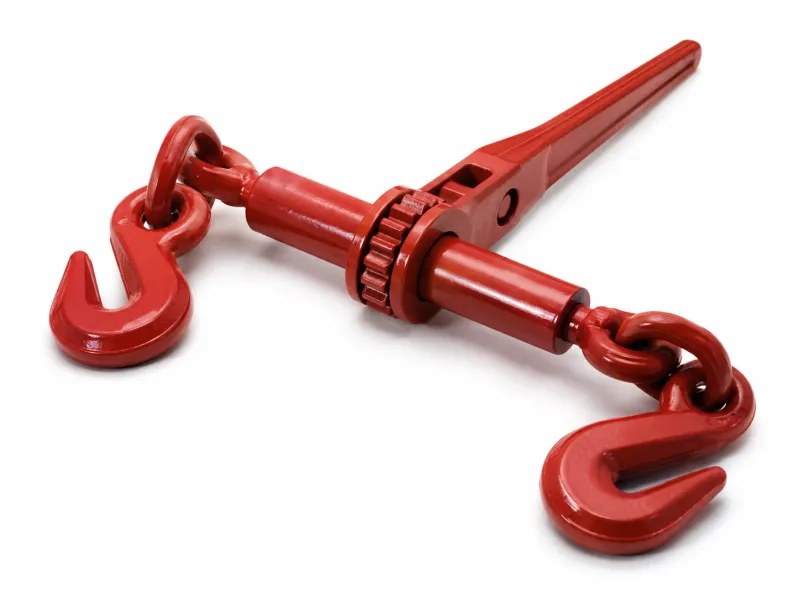
Industrial Steel Load Binder
Heavy-duty industrial ratchet load binder engineered for securing steel coils, machinery, and oversized freight. Features a drop-forged steel ratchet handle, hardened grab hooks, and a corrosion-resistant finish for demanding transport applications. Delivers reliable tensioning, EN 12195-2 and DOT compliance, and a 3:1 safety factor for professional cargo control operations.
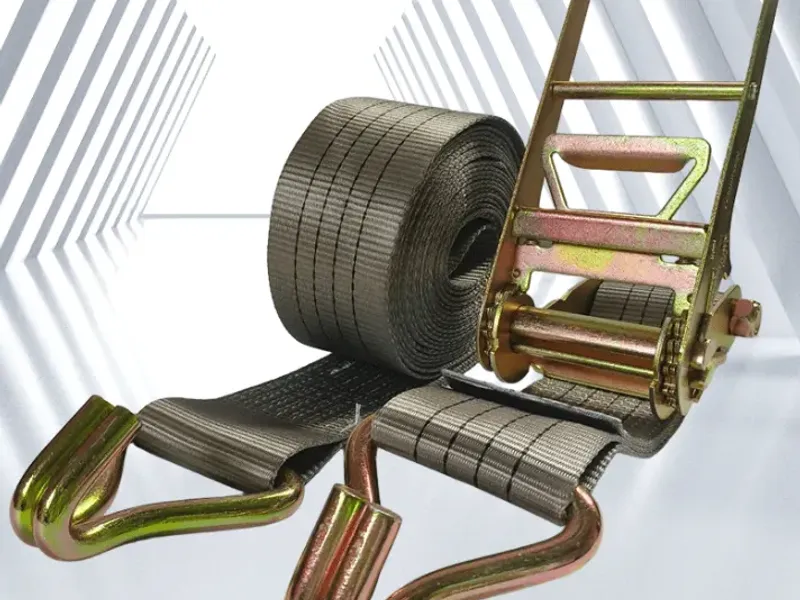
Standard Heavy Duty Ratchet Strap
Standard Heavy Duty Ratchet Strap with 2" polyester webbing and forged wire hooks, delivering a 10,000 lbs breaking strength and 3,333 lbs working load limit. Engineered for reliable cargo securement on flatbeds, trailers, and pickups, it offers corrosion-resistant hardware, low-stretch webbing, and a smooth-action ratchet for repeatable, safe tie-downs.
Related Categories
Related Applications
Related Industries
Compare sourced load binders against DIY tie-down builds — specs, safety, and total cost
Request a Wholesale Quote for Load Binders and Tie-Down Hardware