

When sourcing carabiner clips wholesale for industrial use, certification compliance is not optional — it is a legal and operational baseline. Whether you are equipping a construction crew, outfitting a rigging team, or building out a fall-arrest system, every carabiner in the supply chain must meet specific load ratings and safety standards validated by recognized third-party bodies. As of 2026, the primary frameworks governing industrial carabiners are CE marking under EN 362, ANSI Z359.12 in North America, and OSHA fall-protection regulations. This guide breaks down each standard, explains what buyers must verify before placing a wholesale order, and outlines how trustwebbing's Industrial Safety Carabiners are built to comply.
Why Certifications Matter for Industrial Carabiner Wholesale Orders
The Stakes of Non-Compliant Hardware
In industrial environments — construction sites, oil platforms, warehousing, and aerospace ground operations — carabiner clips are load-bearing safety-critical components. A non-certified unit may look identical to a certified one but lack the validated gate strength, proof load testing, or material traceability that regulations demand.
- Liability exposure: distributing or installing non-compliant carabiners can result in OSHA citations, project shutdowns, and civil liability in the event of equipment failure.
- Insurance implications: many commercial liability and workers' compensation policies require documented use of certified PPE hardware.
- Export restrictions: carabiners shipped into the EU must carry CE marking; units entering North American markets must reference ANSI Z359.12 or equivalent.
Compliance vs. Non-Certified: A Direct Comparison
| Factor | CE / ANSI Certified | Non-Certified (Generic) |
| Gate load tested | Yes — minimum 7 kN side load | Not verified |
| Major axis WLL documented | Yes — typically **22 kN** | No traceable spec |
| Third-party audit trail | Required | Absent |
| Accepted by OSHA / HSE inspectors | Yes | No |
| Acceptable for fall-arrest systems | Yes | No |
Compared to generic hardware sourced without documentation, certified carabiners reduce compliance risk and provide a clear audit trail — a requirement on virtually every managed construction or industrial project globally.
Key Certifications That Apply to Industrial Carabiner Clips
CE Marking Under EN 362:2004
EN 362 is the European standard for connectors used in personal protective equipment (PPE) against falls. CE marking under this standard is mandatory for any carabiner sold or used as PPE within the European Economic Area.
Core EN 362 requirements:
- Major axis static load: minimum 20 kN
- Minor axis (cross-load) resistance: minimum 7 kN
- Open-gate resistance: minimum 7 kN
- Gate mechanism: must resist accidental opening; screw-gate and twist-lock designs are preferred for industrial use
- Material traceability and batch marking required on every unit
ANSI Z359.12 — North American Standard
For wholesale buyers supplying the US and Canadian markets, ANSI Z359.12 (Connecting Components for Personal Fall Arrest Systems) is the applicable standard. It specifies:
- Minimum breaking strength: 22.2 kN (approximately 4,990 lbf) on the major axis
- Proof load testing at 12 kN before units leave the factory
- Gate must withstand 11.1 kN in the open position
- Annual re-inspection cycles are required once hardware is in service
OSHA 29 CFR 1926.502 (Construction) and 1910.140 (General Industry)
OSHA does not issue product certifications itself, but it mandates that all connectors used in fall protection systems meet ANSI or equivalent standards. Bulk buyers supplying US job sites must ensure each unit is ANSI-compliant and that conformity documentation is on file.
CE + ANSI: Dual-Compliant Units for Global Supply Chains
For distributors serving both North American and European markets, specifying dual CE/ANSI compliant carabiners — such as trustwebbing's Industrial Safety Carabiners, which carry CE and ANSI compliance — simplifies procurement and reduces the need to manage separate SKUs per region.
| Standard | Region | Major Axis Min. | Open Gate Min. | Gate Type Requirement |
| EN 362 (CE) | EU / EEA | 20 kN | 7 kN | Auto-lock preferred |
| ANSI Z359.12 | USA / Canada | **22 kN** | 11.1 kN | Self-closing required |
| AS/NZS 1891.4 | Australia/NZ | 22 kN | 7 kN | Self-locking |
*Note: always verify the applicable national standard for the destination market before finalizing a wholesale order.*
Gate Types and Their Compliance Implications
Choosing the Right Gate Mechanism for Industrial Applications
The gate mechanism directly affects which certifications a carabiner can achieve and which applications it is legally suited for. As of 2026, EN 362 classifies connectors into four types by gate mechanism:
- Type B (Basic) — snap gate; suitable for positioning but not recommended as the sole fall-arrest connector in dynamic-load applications
- Type Q (Screw Gate) — manually locked; widely used in rigging and rescue; compliant for EN 362 fall-arrest when correctly locked
- Type A (Auto-Lock / Twist-Lock) — self-locking without user intervention; required by many site safety standards and preferred by ANSI Z359.12 for primary connectors
- Type T (Twist-Lock with secondary action) — highest resistance to accidental opening; standard in confined-space and offshore applications
trustwebbing Industrial Safety Carabiners: Gate Options
trustwebbing's Industrial Safety Carabiners are available in three gate configurations to match application requirements:
| Gate Type | Recommended Application | Certification Applicable |
| Snap Gate | Rigging, anchor points, non-dynamic loads | CE / ANSI Compliant |
| **Screw Gate** | Fall arrest, work-positioning, rescue | CE / ANSI Compliant |
| **Twist Lock** | Offshore, confined space, primary connectors | CE / ANSI Compliant |
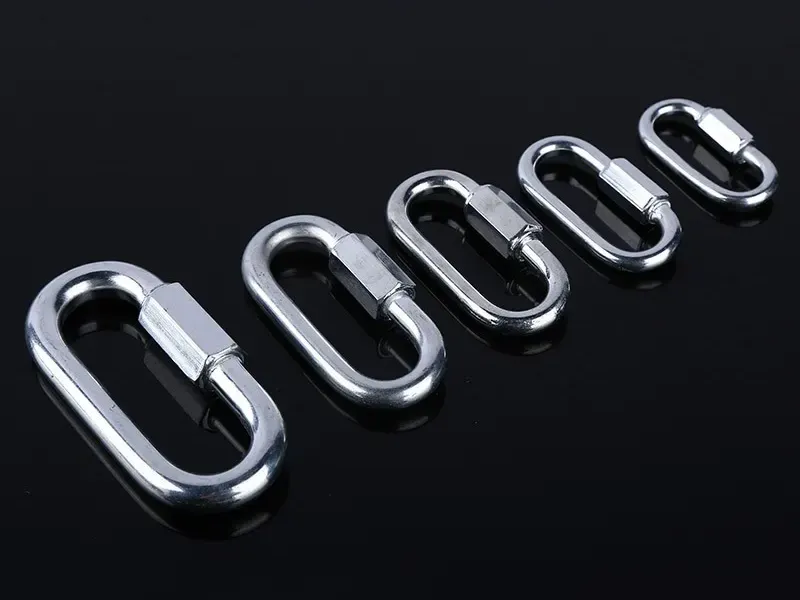
- Material: Galvanized Steel (heavy-load industrial) or Aluminum (weight-sensitive applications)
- WLL: 22 kN on the major axis — meets both EN 362 and ANSI Z359.12 thresholds
- Batch traceability markings on every unit for QC audit compliance
For Lifting & Rigging and Construction & Infrastructure procurement teams, specifying the correct gate type up front prevents costly mid-project hardware substitutions.
What to Verify When Placing a Wholesale Carabiner Order
Wholesale Compliance Checklist
Before committing to a bulk carabiner order for industrial use, buyers should request and review the following documentation from any supplier:
Required Documentation
- CE Declaration of Conformity (DoC) — confirms the product was assessed against EN 362 by a Notified Body; must name the issuing body and standard version
- ANSI Z359.12 Test Reports — third-party laboratory test results showing breaking strength ≥ 22 kN and open-gate strength ≥ 11.1 kN
- Batch/Lot Numbers and Traceability Records — required for warranty claims, site audits, and product recall capability
- Material Certificates — confirmation of steel or aluminum alloy grade (e.g., 5052 or 7075 aluminum; grade 8.8 or higher for steel hardware)
- Load Marking on Unit — per EN 362, every carabiner must be permanently marked with the WLL, manufacturer code, and year of manufacture
Red Flags to Reject
- Certificate copies with no Notified Body registration number
- Units marked only "WLL 22 kN" without a traceable test report
- Certificates dated more than 5 years prior without re-certification evidence
- Supplier unable to provide batch-level documentation for orders over 500 units
Ordering in Bulk: MOQ and Sample Protocol
For industrial wholesale programs, we recommend requesting a certified sample set of 10–20 units from the target production batch before committing to full volume. This allows in-house or third-party verification against the provided test reports. trustwebbing supports sample requests across all carabiner variants prior to bulk order finalization.
For projects involving Cargo Securement & Transportation or Oil, Gas & Energy applications, site safety officers typically require documentation packages within 5 business days of hardware delivery — confirm this capability with your supplier before ordering.
Industry-Specific Certification Requirements for Carabiner Clips
Certifications Vary by Sector
Beyond the baseline EN 362 and ANSI Z359.12 standards, specific industries impose additional or alternative requirements. Wholesale buyers supplying into these verticals must account for sector-specific compliance layers:
Construction & Infrastructure
- OSHA 1926.502 mandates self-locking connectors for all leading-edge fall-arrest applications
- Many general contractors require ISO 9001-certified manufacturing facilities — not just product certification — as a prerequisite for approved vendor lists
- Carabiners must be re-inspected every 12 months or after any load event exceeding normal use
Marine & Shipping
- Salt-spray resistance testing per ISO 9227 is commonly required in addition to structural certifications
- Marine & Shipping applications often specify stainless steel or galvanized hardware; aluminum is generally not accepted for primary marine safety connectors
- MIL-Spec compliance may be required for defense maritime contracts
Oil, Gas & Energy
- Offshore platforms typically require compliance with NORSOK R-002 (Lifting Equipment) in addition to EN 362
- ATEX or IECEx ratings may be needed if carabiners are used in potentially explosive atmospheres
- Suppliers must maintain documented ISO 9001 quality management systems
Aerospace & Defense
- Aerospace ground-support and military applications may require MIL-SPEC connectors (e.g., MIL-DTL-83578 for snap hooks)
- Lot acceptance testing with full traceability to raw material certificates is standard
- Military & Defense contracts typically specify CAGE codes and government-approved supplier registration
Logistics & Transportation
- For carabiners used in cargo securement rather than fall arrest, WSTDA (Web Sling and Tie Down Association) standards and DOT regulations under 49 CFR Part 393 are the relevant frameworks
- Trucking & Logistics buyers should distinguish between fall-protection carabiners (EN 362 / ANSI Z359) and load-securement snap hooks (governed by DOT and WSTDA), as they carry different load ratings and are not interchangeable
| Industry | Primary Standard | Additional Requirements |
| Construction | ANSI Z359.12 / EN 362 | OSHA 1926.502, ISO 9001 facility |
| Marine | EN 362 + ISO 9227 | MIL-Spec (defense), stainless steel |
| Oil & Gas | EN 362 + NORSOK R-002 | ISO 9001, ATEX if applicable |
| Aerospace / Defense | MIL-SPEC / EN 362 | Full lot traceability, CAGE code |
| Logistics | DOT 49 CFR 393 / WSTDA | Distinct from fall-arrest standards |
Frequently Asked Questions
What is the minimum WLL for a carabiner to be considered compliant for industrial fall-arrest use?
For fall-arrest applications, both EN 362 (CE) and ANSI Z359.12 require a minimum breaking strength of 22 kN on the major axis. The open-gate strength must meet at least 7 kN under EN 362 and 11.1 kN under ANSI Z359.12. trustwebbing's Industrial Safety Carabiners are rated at 22 kN WLL on the major axis, meeting both thresholds and making them suitable for wholesale supply into both European and North American industrial markets.
Can the same carabiner be used for both cargo securement and fall protection?
No — this is a critical compliance distinction. Carabiners certified under EN 362 or ANSI Z359.12 are designed and tested for fall-arrest loads (dynamic shock loads up to 6 kN body force under ANSI). Snap hooks and carabiners used in cargo securement are governed by DOT 49 CFR Part 393 and WSTDA standards, which evaluate sustained static loads rather than dynamic impact. Using a fall-protection carabiner as a load-securement connector — or vice versa — may violate regulatory requirements and void the product certification. Always verify the application category before specifying hardware.
How do I verify that a CE certificate for a carabiner is genuine?
A genuine CE Declaration of Conformity (DoC) must include: the name and address of the manufacturer, the product description and model number, a reference to the specific harmonized standard (e.g., EN 362:2004), the name and registration number of the Notified Body that performed the assessment, the date of issue, and an authorized signature. You can cross-reference the Notified Body registration number against the European Commission's NANDO (New Approach Notified and Designated Organisations) database. For wholesale orders exceeding 500 units, always request batch-specific test reports in addition to the general DoC.
Do aluminum carabiners meet the same certification standards as steel for industrial use?
Yes — certification standards such as EN 362 and ANSI Z359.12 are performance-based, not material-prescriptive. An aluminum carabiner that achieves 22 kN breaking strength and 7 kN open-gate resistance carries the same certification status as a steel unit meeting those thresholds. However, the application environment determines suitability: aluminum is generally not accepted in marine saltwater applications or where abrasion from sharp steel edges is a factor. Galvanized steel carabiners are preferred for offshore, heavy rigging, and environments with chemical or mechanical wear. trustwebbing's Industrial Safety Carabiners are available in both Galvanized Steel and Aluminum, each CE and ANSI compliant.
What documentation should a wholesale supplier provide with each carabiner shipment?
For a compliant wholesale carabiner shipment, buyers should receive: (1) CE Declaration of Conformity referencing EN 362:2004 with Notified Body number; (2) ANSI Z359.12 third-party test reports if supplying North American markets; (3) batch/lot number records matching units in the shipment; (4) material certificates for steel or aluminum alloy grade; (5) a product instruction sheet covering inspection intervals, retirement criteria, and proper use — required under EN 365 for PPE connectors. For large industrial procurement programs, also request the supplier's ISO 9001 facility certificate to confirm the quality management system governing production.
Related Resources
Related Categories
Related Applications
Related Industries
Understand CE, ANSI, and OSHA compliance requirements before sourcing industrial carabiners in bulk
Request Certified Carabiner Samples for Your Project