
Marine & Shipping
Technical Description
At a Glance
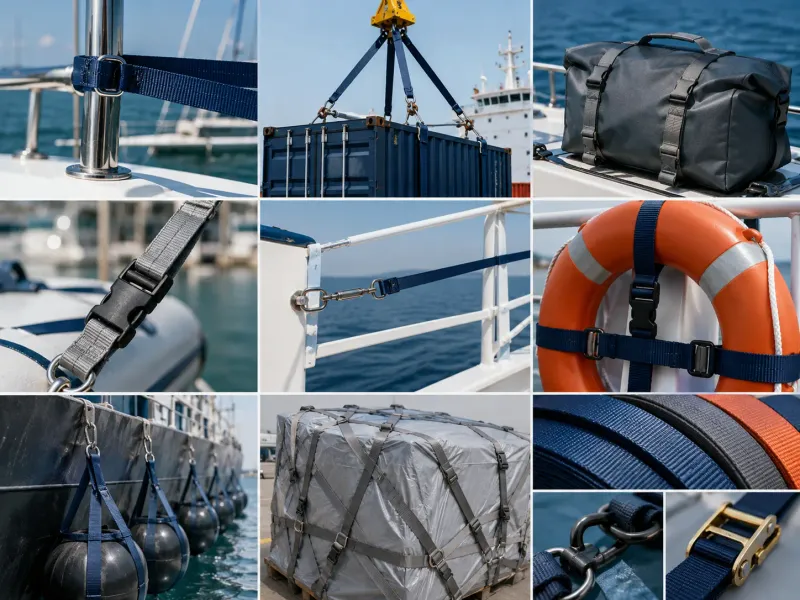
Marine and shipping operations expose cargo control equipment to the harshest working conditions in the transportation sector: constant saltwater spray, high humidity, UV exposure, and the dynamic loads generated by vessel pitch, roll, and heave. In this environment, tie-down straps must secure containers, machinery, boats, and palletized freight against multi-directional forces that shift continuously throughout a voyage. Reliable cargo control is not optional here—strap failure at sea can result in shifted loads, capsizing risk, crushed goods, environmental spills, and injury, which is why corrosion-resistant, high-strength restraint systems are a core safety requirement for any marine logistics operation.
Performance Data
Marine-grade tie-down straps must meet stringent mechanical and material specifications to perform safely in a corrosive, high-vibration environment. Buyers sourcing for shipping applications should verify the following benchmarks:
- Working Load Limit (WLL): Typical assemblies range from 1,500 kg to 5,000 kg (3,300–11,000 lbs) depending on webbing width; heavy container lashing configurations reach 5,000 kg WLL per strap.
- Breaking Strength (BS): Minimum breaking strength of 5,000 kg for 50 mm webbing and up to 10,000 kg+ for reinforced marine assemblies, with the ratchet hardware matched to exceed webbing capacity.
- Safety Factor: A minimum 3:1 ratio (BS to WLL) per EN 12195-2, with many marine buyers specifying 2:1 hardware-to-webbing margins for the metal components to ensure the weakest link remains the webbing.
- Governing Standards: Compliance with EN 12195-2 (European lashing standard), DOT / FMCSA §393 (North American cargo securement), ASTM D3950 (webbing tie-down specification), and AS/NZS 4380 where applicable for Pacific routes.
- Corrosion Resistance: Hardware fabricated from 316 stainless steel, which contains 2–3% molybdenum for superior pitting resistance in chloride-rich saltwater environments—significantly outperforming 304 stainless and zinc-plated steel.
- Webbing Material: 100% high-tenacity polyester with <3% elongation at WLL, low water absorption, and UV-stabilized fibers rated for prolonged marine exposure.
- Temperature Range: Operational stability from −40°C to +100°C (−40°F to +212°F), covering both polar shipping lanes and hot equatorial deck conditions.
- Elongation & Abrasion: Polyester webbing offers minimal stretch (7% max at break) and high abrasion resistance, maintaining tension integrity through repeated load cycling at sea.
| Specification | Value |
| Webbing width | 25 mm / 35 mm / 50 mm / 75 mm |
| WLL range | 1,500 – 5,000 kg |
| Breaking strength | 5,000 – 10,000+ kg |
| Safety factor | 3:1 (min per EN 12195-2) |
| Hardware material | 316 stainless steel |
| Webbing material | 100% high-tenacity polyester |
| Elongation at WLL | < 3% |
| Temperature range | −40°C to +100°C |
| Standards | EN 12195-2, DOT/FMCSA, ASTM D3950 |
Recommended Solutions
For marine and shipping duty, Marine Grade Straps are engineered specifically to resist the saltwater corrosion and UV degradation that destroy standard zinc-plated or galvanized assemblies within a single season. This category pairs UV-stabilized polyester webbing with corrosion-proof fittings, delivering consistent WLL performance across the full service life even under continuous chloride exposure.
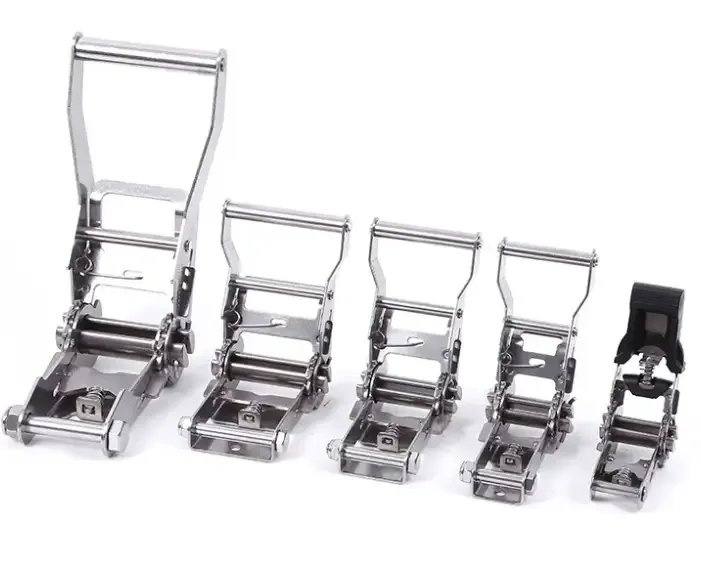
The flagship product for this application is the 316 Marine Grade Ratchet Strap, which uses 316-grade stainless steel ratchet mechanisms, end fittings, and hooks to guarantee reliable tensioning and release even after prolonged immersion or spray. With a 3:1 safety factor, sub-3% elongation, and hardware that meets or exceeds the webbing breaking strength, the 316 Marine Grade Ratchet Strap is suited for container lashing, deck cargo, and on-vessel machinery restraint where standard straps would seize, pit, or fail. Every unit within the Marine Grade Straps range is built to serve the demanding requirements of the Logistics & Transportation industry, from port handling through open-ocean transit.
Where It's Used
Marine-grade ratchet straps are deployed across a wide spectrum of shipping, port, and offshore scenarios where corrosion resistance and load security are equally critical:
- Container and deck cargo lashing: Securing intermodal containers, break-bulk freight, and palletized goods to deck fittings and lashing points against roll and pitch forces during transit.
- Boat and yacht transport: Restraining vessels on trailers, cradles, and transport frames for both over-water shipment and dockside handling, where saltwater exposure is constant.
- Offshore and marine machinery restraint: Tying down generators, winches, pumps, and equipment on supply vessels, barges, and offshore platforms subject to continuous vibration and spray.
- Port and dockside logistics: Handling and staging of cargo within terminal operations, where straps are repeatedly wetted, exposed to UV, and cycled under load.
- Aquaculture and fishing operations: Securing nets, cages, traps, and gear on working vessels where hardware faces relentless immersion and chloride attack.
- Coastal and inland waterway freight: Restraining loads on barges, ferries, and river transport where humidity and splash accelerate corrosion of non-marine hardware.
Sourcing & Bulk Orders
As a dedicated China-based cargo control manufacturer, TrustWebbing supplies Marine Grade Straps to wholesale, OEM, and distribution buyers worldwide with full customization across webbing, hardware, and packaging. Our production is structured for bulk export and private-label programs serving the global Logistics & Transportation market.
Minimum Order Quantity (MOQ):
- Standard configurations: 500 pieces per SKU
- Custom OEM / private-label programs: 1,000 pieces per SKU
- Sample orders available for quality evaluation prior to bulk commitment.
Custom Lengths & Widths:
- Webbing widths: 25 mm, 35 mm, 50 mm, and 75 mm
- Custom assembly lengths from 1 m to 15 m+ to match container lashing points, trailer configurations, and vessel deck layouts.
- Choice of end fittings: S-hooks, J-hooks, snap hooks, D-rings, and flat hooks—all available in 316 stainless steel.
OEM & Private Label:
- Custom webbing colors and printed logos woven or heat-transferred onto the strap.
- Branded ratchet handles, custom labeling, and retail-ready or bulk industrial packaging.
- Custom WLL and breaking-strength specifications engineered to buyer requirements.
Certifications & Compliance:
- Products manufactured to EN 12195-2, DOT/FMCSA §393, and ASTM D3950 standards.
- ISO 9001 certified manufacturing with GS, TÜV, and CE documentation available on request.
- Full test certificates, break-test reports, and traceable material specifications supplied with each order.
Lead Time:
- Sample lead time: 7–10 days
- Bulk production: 20–35 days depending on order volume and customization complexity.
- Repeat orders on established specifications: 15–25 days.
Export & Logistics:
- Experienced in FOB, CIF, and DDP shipping terms to ports across North America, Europe, Australia, the Middle East, and Southeast Asia.
- Container-optimized packaging to maximize load efficiency and minimize freight cost per unit.
- Consolidated shipping available for mixed-SKU orders across the Marine Grade Straps category and other cargo control product lines.
The 316 Marine Grade Ratchet Strap and the broader Marine Grade Straps range give importers, distributors, and industrial buyers a corrosion-resistant, standards-compliant restraint solution built for the realities of marine transport—backed by scalable manufacturing, verified certifications, and reliable export support for the worldwide Logistics & Transportation sector.
Need Marine & Shipping Solutions?
Our engineering team can develop custom functional fabric solutions for your specific marine & shipping requirements.
Request a Technical Quote