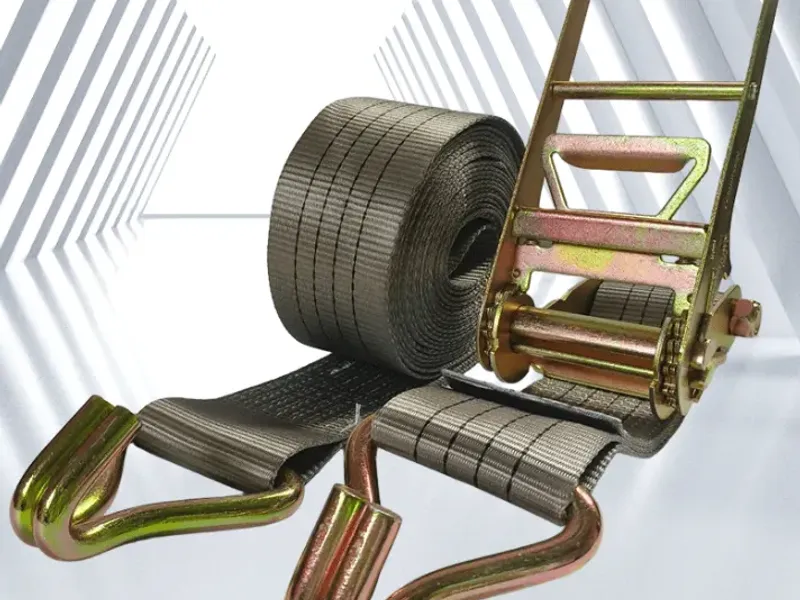
The Working Load Limit (WLL) is not just a number printed on a strap label; it is the mathematical result of rigorous physics testing and safety factor calculations. For B2B logistics and construction procurement, a fundamental understanding of WLL is the difference between a compliant, safe operation and a costly liability disaster.
This guide breaks down the engineering behind our cargo control products. We explain the '3:1' and '5:1' safety factors, the impact of G-forces on cargo, and why selecting the correct WLL is critical for meeting international FMCSA and OSHA regulations.
The Impact of Webbing Width on Load Capacity
Why does a 3-inch strap have a much higher WLL than a 1.5-inch strap? It comes down to surface area and internal thread density. Understanding these mechanics helps procurement managers specify the exact hardware needed for their specific heavy-haul requirements.
The Critical Safety Margin: Break Strength vs. Working Load Limit
A fundamental concept in load securement is the distinction between break strength and working load limit (WLL). Break strength is the force at which the equipment fails catastrophically, while WLL is the maximum load that should ever be applied in normal service. For example, a Standard Heavy Duty Ratchet Strap in 2-inch width has a break strength of 10,000 lbs but a WLL of only 3,333 lbs, reflecting a 3:1 safety factor. This margin is not arbitrary; it accounts for dynamic forces, wear, and shock loads during transport. Industrial Steel Load Binders are also engineered with this 3:1 safety factor, offering capacities from 10 to 25 tons, ensuring reliable restraint even under rough terrain or emergency maneuvers.
Webbing Width and Material: The Determinants of WLL in Tiedown Assemblies
WLL is directly proportional to the cross-sectional area and material integrity of the webbing. Compare the Standard Utility & Tarp Straps, which use 1-inch polyester or polypropylene webbing with a WLL of just 100 to 300 lbs, to a 1.5-inch Standard Heavy Duty Ratchet Strap rated at 3,333 lbs. The tenfold increase in WLL comes from wider, denser 1000D polyester construction and premium hardware. Similarly, Double Eye Polyester Webbing ranges from 1-inch at 1,500 lbs up to 12-inch at 40,000 lbs, demonstrating how width scales WLL for lifting and lashing applications. Industrial-grade 1000D high-tenacity polyester, like that found in High-Performance Industrial Webbing Roll, meets WSTDA/ISO 9001 standards, ensuring consistent WLL from batch to batch.
Directional Load Limits: Why WLL Changes with Angle and Orientation
WLL is not a fixed number; it varies with the direction of force applied. The E-Track Ratchet Strap Assembly clearly illustrates this: its WLL is 1,600 lbs when lifting vertically (straight pull) but rises to 3,333 lbs for drag or horizontal restraint. This difference arises because the assembly's swivel and track engagement distribute stress differently in each mode. Similarly, Industrial Safety Carabiners are rated at 22 kN only on the major axis; loading across the gate or minor axis can reduce capacity by over 70%. Always consult manufacturer data for multi-leg sling hitches, where a 60-degree angle might derate a Woven Polyester Lifting Sling from its 20,000 lbs vertical WLL down to half that value.
Environmental Derating: Protecting WLL in Harsh Conditions
Exposure to UV, moisture, chemicals, and extreme temperatures can permanently reduce WLL. Standard polyester webbing loses approximately 15% of its tensile strength after 1,000 hours of accelerated UV testing (equivalent to a year of outdoor service). The 316 Marine Grade Ratchet Strap combats this with black UV-resistant polyester webbing and 316 stainless steel hardware, maintaining its WLL of 1,600 to 3,333 lbs even after prolonged saltwater exposure. In contrast, zinc-plated carbon steel on a Forged End Hook or Heavy Duty Ratchet Buckle Assembly may show corrosion within months in marine environments, compromising the assembly's WLL. When operating in oil, gas, or construction settings, inspect gear daily and derate by at least 20% when visible deterioration is present, as per WSTDA guidelines.