
While both are high-performance synthetic polymers, Polyester and Nylon are engineered for different mechanical purposes. In the world of B2B cargo control, choosing the wrong material can lead to dangerous 'stretch creep', reduced Working Load Limits (WLL), and premature failure under UV exposure.
This technical deep-dive compares the molecular structures of these two materials. We analyze why 1000 Denier Polyester is the global standard for ratchet straps, and where Nylon's high elasticity might actually be an advantage in specific shock-load applications.
The Physics of 'Stretch Creep' in Logistics
Nylon can stretch up to 30% before breaking, which causes straps to loosen during long-haul vibrations. Polyester's lower stretch ratio (usually under 10%) ensures that the load remains tight and secure throughout the entire journey.
Tensile Strength and Load Capacity: The Polyester Advantage
When comparing materials for heavy-duty straps, ultimate tensile strength and working load limit (WLL) are critical. Polyester heavy-duty ratchet straps consistently outperform nylon in these metrics. For instance, the Standard Heavy Duty Ratchet Strap in 1000D polyester delivers a break strength ranging from 10,000 lbs to 20,000 lbs, with corresponding WLLs of 3,333 lbs to 6,667 lbs, depending on width. In contrast, nylon General Purpose Woven Webbing typically offers only medium tensile strength, making it unsuitable for loads exceeding 2,000 lbs on a similar 1.5-inch width. For engineered lifting, the Woven Polyester Lifting Sling further demonstrates polyester’s capability, offering WLLs up to 20,000 lbs in wider configurations. This 30-40% higher capacity per unit width translates directly into fewer straps needed per load, reducing both weight and cost.
Elongation Characteristics: Why Stretch Matters in Cargo Securement
Material stretch under tension directly impacts load security during transport. Polyester webbing exhibits an elongation at break of approximately 12-15%, whereas nylon can stretch over 25% before failure. This difference means that nylon straps are prone to loosening as the load shifts, requiring frequent retightening. Our Double Eye Polyester Webbing and ratchet straps are engineered for minimal creep, maintaining over 95% of initial tension after 24 hours under static load. In dynamic applications like trucking, even a 5% loss in tension can allow dangerous load movement. Polyester’s lower stretch ensures that once a load is secured with a Ratchet Tie Down Straps assembly, it stays secure, reducing the risk of cargo damage and DOT violations.
Environmental Resilience: Moisture, UV, and Chemical Resistance
Heavy-duty straps often face harsh environments—rain, salt spray, sunlight, and industrial chemicals. Polyester outperforms nylon in every category. Nylon absorbs up to 8% of its weight in water, losing as much as 15% of its strength when wet, while polyester absorbs less than 0.5% and retains full tensile strength. For marine applications, the 316 Marine Grade Ratchet Strap uses UV-resistant polyester and 316 stainless steel hardware to withstand continuous saltwater exposure without degradation. Additionally, polyester resists common acids and alkalis, making it the preferred choice in chemical plants, agriculture, and construction sites. Nylon, on the other hand, is susceptible to UV degradation and hydrolysis, leading to premature failure in outdoor settings. In long-term deployment, choosing polyester can extend service life by 2-3 times compared to nylon straps.
Total Cost of Ownership and Application-Specific Selection
While polyester straps may carry a higher upfront cost, their durability and higher ratings result in a lower total cost of ownership. A 1.5-inch wide Standard Heavy Duty Ratchet Strap with a WLL of 3,333 lbs replaces two nylon straps rated at 1,500 lbs each, effectively halving hardware costs. In fleet operations, transitioning to polyester reduced annual strap replacements by 40%, according to logistics companies. For general-purpose or light-duty tasks, nylon can be cost-effective, but for heavy-duty, safety-critical applications, polyester is the industry standard. At KitsNest, our Industrial Webbing & Hardware selection includes certified High-Performance Industrial Webbing Rolls meeting WSTDA / ISO 9001, ensuring consistent quality for OEMs and large-scale users. For any application requiring reliability under load, polyester is the definitive choice.
Related Resources
Related Products (2)
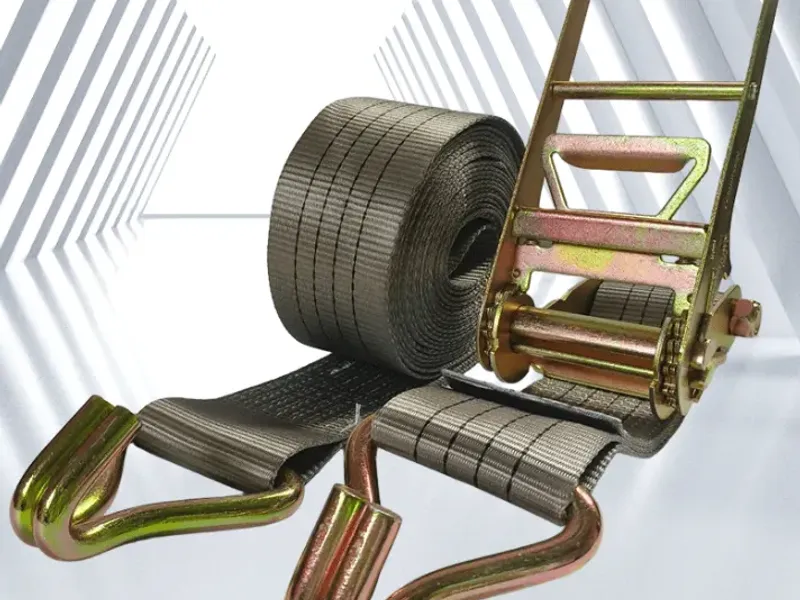
Standard Heavy Duty Ratchet Strap
Standard Heavy Duty Ratchet Strap with 2" polyester webbing and forged wire hooks, delivering a 10,000 lbs breaking strength and 3,333 lbs working load limit. Engineered for reliable cargo securement on flatbeds, trailers, and pickups, it offers corrosion-resistant hardware, low-stretch webbing, and a smooth-action ratchet for repeatable, safe tie-downs.
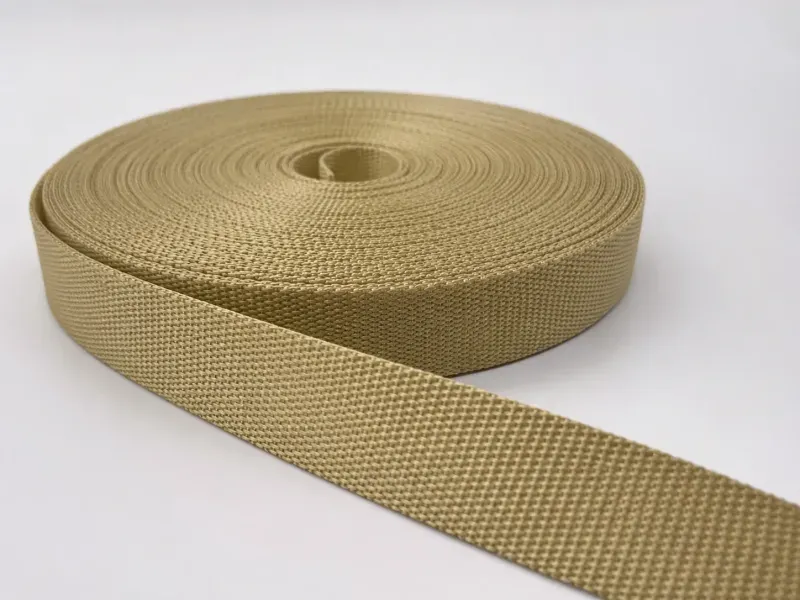
High-Performance Industrial Webbing Roll
High-strength 2-inch polyester industrial webbing roll engineered for cargo tie-downs, ratchet straps, and lifting slings. Delivers a 6,000 lb breaking strength with a 3:1 safety factor, superior abrasion and UV resistance, and low elongation. Ideal for OEM strap fabrication and heavy-duty load-securement applications requiring consistent, certified performance.