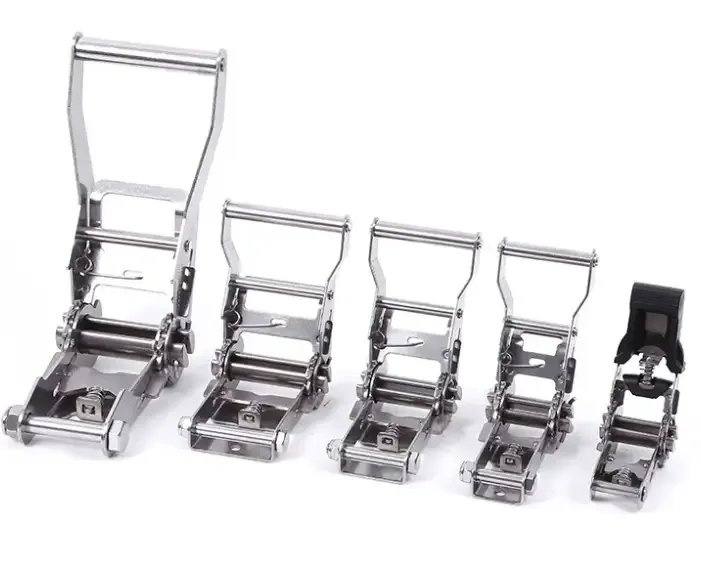
In the marine industry, rust is not just an eyesore—it is a structural failure waiting to happen. When a standard galvanized strap is exposed to saltwater, the chloride ions penetrate the zinc coating, leading to rapid pitting and catastrophic snap-back potential. For boat trailers, offshore rigs, and maritime logistics, marine-grade components are not optional.
This technical deep-dive explains the metallurgy behind 316 Stainless Steel. We compare it against 304 SS and galvanized alternatives, detailing why the addition of Molybdenum makes 316 the industry standard for heavy-duty marine cargo control.
UV Resistance: The Hidden Factor in Marine Webbing
While the hardware handles salt, the webbing handles the sun. We use black polyester webbing compounded with advanced UV inhibitors. Without this, standard polyester loses up to 20% of its tensile strength after a single season of exposure.
Understanding 316 Stainless Steel: Composition and Performance
The 316 Marine Grade Ratchet Strap derives its exceptional corrosion resistance from a metallurgical composition that includes 16-18% chromium, 10-14% nickel, and 2-3% molybdenum. This molybdenum addition is critical, raising the Pitting Resistance Equivalent Number (PREN) to over 25, which enables the steel to withstand chloride concentrations up to 1,000 ppm without pitting. In contrast, standard 304 stainless steel, with a PREN around 18, begins to pit at just 100 ppm chloride. With a tensile strength of approximately 75,000 psi and a yield strength of 30,000 psi, 316 stainless maintains structural integrity under the constant dynamic loads typical of marine cargo operations.
Load Capacity and Design Integrity of Marine-Grade Straps
The 316 Marine Grade Ratchet Strap is engineered with a Working Load Limit (WLL) ranging from 1,600 lbs to 3,333 lbs, with a break strength that follows a 3:1 safety factor—meaning a 3,333 lb WLL strap achieves an ultimate break strength of approximately 10,000 lbs. The webbing is constructed from black UV-resistant polyester, available in widths of 1.5, 2, or 3 inches, which retains flexibility and strength even after prolonged sun exposure. While the Standard Heavy Duty Ratchet Strap offers a higher maximum WLL of 6,667 lbs, its zinc-plated carbon steel hardware succumbs to red rust within 200 hours of ASTM B117 salt spray testing, whereas 316 stainless steel endures over 1,000 hours—making the marine-grade option essential for saltwater environments.
Certified to Perform: Compliance with Stringent Standards
Every 316 Marine Grade Ratchet Strap is produced in accordance with WSTDA and MIL-Spec requirements, ensuring consistent load-handling performance. The manufacturing facility is ISO 9001 certified, guaranteeing rigorous quality control at every stage. Proof load testing is conducted at 2 times the WLL: a strap rated for 1,600 lbs is tested to 3,200 lbs prior to shipment. This over-testing protocol, combined with traceable material certifications, provides assurance that the straps will perform reliably in critical marine and offshore applications.
Real-World Performance in Marine & Shipping and Oil & Gas
In the Marine & Shipping and Oil, Gas & Energy sectors, the 316 Marine Grade Ratchet Strap is used to secure loads such as drill pipe bundles and onboard cargo. A typical offshore supply vessel might deploy 50 straps with a WLL of 3,333 lbs each to restrain a 150,000 lb load, distributing forces evenly across the deck. The UV-resistant polyester webbing retains over 90% of its tensile strength after 500 hours of accelerated weathering per ASTM G154, and the 316 stainless hardware shows negligible corrosion after 5 years in continuous salt spray. Though the upfront cost is 30-40% higher than standard zinc-plated alternatives, the 5x longer service life reduces total cost of ownership by up to 60% over a 5-year period.