
In the industrial textile market, "Heavy Duty Webbing" is often used as a catch-all term, but for B2B procurement managers, specificity is everything. The difference between a 600 Denier strap used for luggage and a 1000 Denier strap used for heavy machinery is not just in the label—it's in the tensile strength, the abrasion resistance, and the weave density.
This guide breaks down the actual technical differences. We explore how denier weight affects the Working Load Limit (WLL), the pros and cons of polyester vs. nylon, and what you need to specify on a BOM (Bill of Materials) when sourcing from an OEM factory like TrustWebbing.
Understanding Denier: Why 1000D is the Industry Standard
Denier is a unit of measurement for the linear mass density of fibers. Simply put, it is the weight of 9000 meters of the fiber. While 600D polyester is robust enough for consumer backpacks, heavy cargo control requires a minimum of 1000D. The higher denier count ensures the webbing can withstand the extreme friction of steel hooks and the massive tension of a ratchet buckle without fraying.
Understanding Denier and High-Tenacity Polyester Fibers
Industrial heavy-duty webbing begins with fiber selection. The most common specification is 1000D high-tenacity polyester, where 'D' (denier) measures linear mass density. Our High-Performance Industrial Webbing Roll utilizes a 1000D polyester yarn in a high-density weave, achieving exceptional tensile strength with minimal elongation. Available in widths from 1 inch to 4 inches, these rolls meet WSTDA and ISO 9001 standards. Unlike general-purpose webbing that may use 600D or lower grades, 1000D construction delivers up to 40% greater breaking strength per cross-sectional area, making it the benchmark for cargo securement and lifting applications. Custom colors including black, yellow, red, and orange allow for color-coded load rating systems across job sites.
Protective Coatings: Marine Grade vs. Industrial Zinc Plating
Corrosion resistance is a critical differentiator in heavy-duty hardware. Standard carbon steel components on a Standard Heavy Duty Ratchet Strap are zinc plated, offering moderate protection for inland transport and construction—with Working Load Limits (WLL) of 3333 lbs to 6667 lbs. For saltwater or chemical exposure, the 316 Marine Grade Ratchet Strap features 316 stainless steel hardware and UV-resistant polyester webbing, certified to MIL-Spec and WSTDA. Independent salt spray tests show 316 stainless steel endures over 10 times longer than zinc-plated carbon steel before red rust appears, while maintaining WLLs from 1600 lbs to 3333 lbs. This contrast makes material selection essential for total cost of ownership in harsh environments.
Decoding WLL, Break Strength, and Safety Factors
Every heavy-duty webbing product is defined by two numbers: Working Load Limit (WLL) and minimum break strength. For example, a 3-inch Standard Heavy Duty Ratchet Strap carries a WLL of 6667 lbs, but its break strength is 20,000 lbs—a 3:1 safety factor mandated by industry standards. Similarly, the Industrial Steel Load Binder offers capacities from 10 Ton to 25 Ton with a 3:1 safety factor, ensuring the binder can withstand incidental overloads without catastrophic failure. Always select components where the WLL of the weakest link exceeds the maximum anticipated load, and never use break strength as an operating limit. This margin safeguards personnel and cargo in rigging and towing operations.
Hardware Integration: Buckles, Hooks, and End Fittings
Webbing performance is only as reliable as its terminations. The Heavy Duty Ratchet Buckle Assembly features a double-action pawl mechanism for secure locking on webbing widths of 1.5-inch, 2-inch, and 3-inch, with zinc, yellow, or blue plating options. Mating Forged End Hooks—available as S-Hooks, Flat Hooks, J-Hooks, and Safety Hooks—are forged from heat-treated steel with zinc plating or yellow chromate finish, engineered to match 1.5-inch to 3-inch webbing. For custom rigging, Steel Eyelet End Fittings (die-cast zinc alloy or steel) are crimped or riveted onto webbing ends, with pull strengths that exactly match the webbing’s WLL to avoid creating a weak point. These combinations allow field-ready assemblies without field splicing.
Application-Specific Webbing for Lifting, Cargo, and Industrial Towing
Different load geometries demand purpose-built webbing. Vertical lifting often relies on the Double Eye Polyester Webbing, with WLLs ranging from 1,500 lbs up to 40,000 lbs across widths of 1 inch to 12 inches, ideal for sling and basket configurations. The Woven Polyester Lifting Sling offers single-eye or double-eye designs in widths from 2 inches to 12 inches, supporting WLLs up to 20,000 lbs. For logistics, the E-Track Ratchet Strap Assembly provides a 360° swivel with a WLL of 1600 lbs for lifting and 3333 lbs for drag restraint, compatible with E-Track and T-Track systems. On the road, the Retractable Ratchet Strap System speeds tie-down with spring-loaded auto-retraction in lengths from 12 ft to 40 ft. Selecting the right configuration prevents load shift and ensures DOT compliance.
Related Resources
Related Products (2)
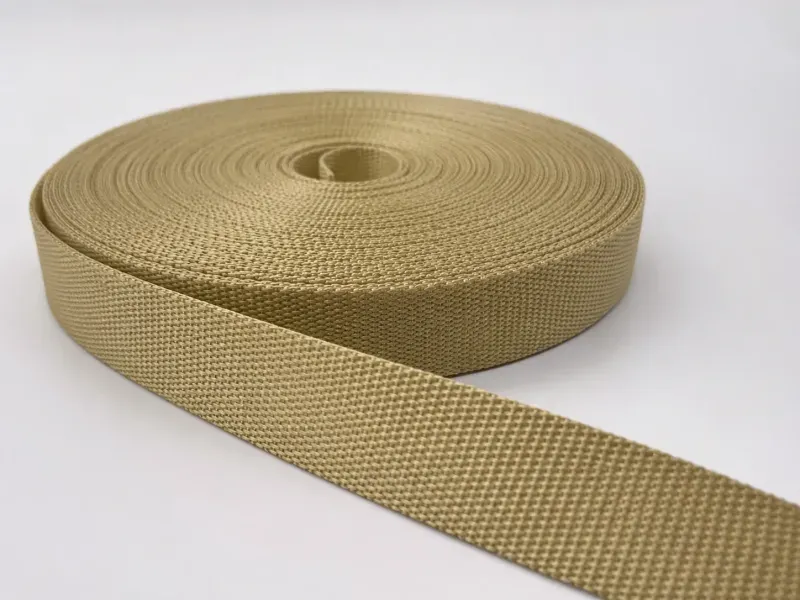
High-Performance Industrial Webbing Roll
High-strength 2-inch polyester industrial webbing roll engineered for cargo tie-downs, ratchet straps, and lifting slings. Delivers a 6,000 lb breaking strength with a 3:1 safety factor, superior abrasion and UV resistance, and low elongation. Ideal for OEM strap fabrication and heavy-duty load-securement applications requiring consistent, certified performance.
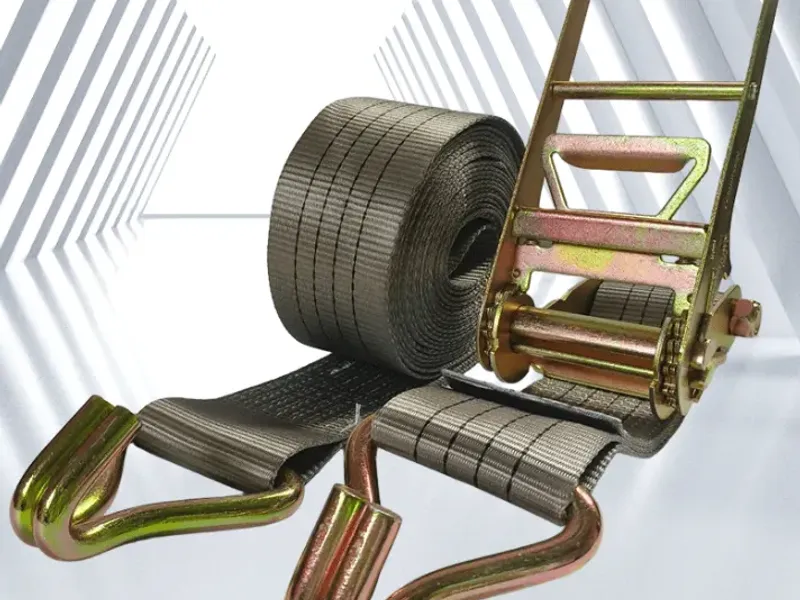
Standard Heavy Duty Ratchet Strap
Standard Heavy Duty Ratchet Strap with 2" polyester webbing and forged wire hooks, delivering a 10,000 lbs breaking strength and 3,333 lbs working load limit. Engineered for reliable cargo securement on flatbeds, trailers, and pickups, it offers corrosion-resistant hardware, low-stretch webbing, and a smooth-action ratchet for repeatable, safe tie-downs.