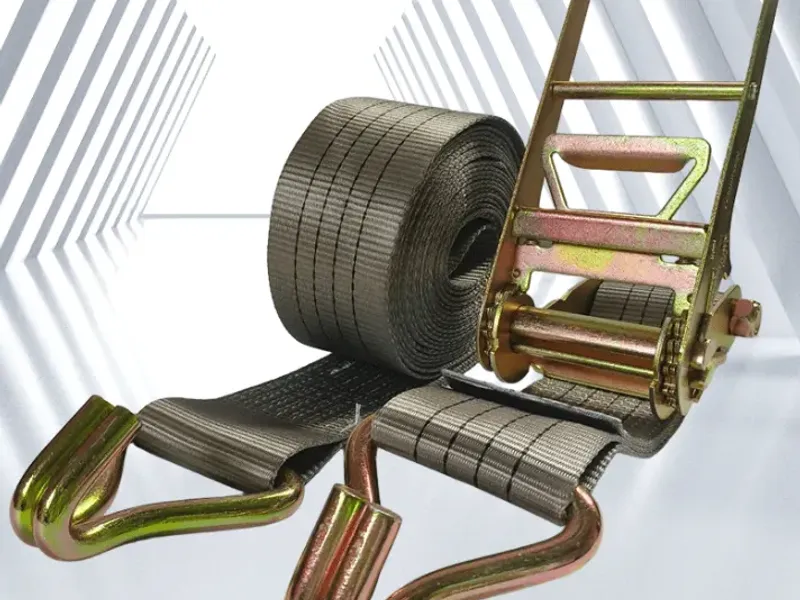
For global buyers and distributors, accepting a container of industrial webbing is a high-stakes decision. A single defect in the weaving or a hardware casting flaw can lead to massive liabilities in the field. Quality assurance isn't just about meeting specs; it's about risk management.
This guide outlines the industry standards for B2B cargo control inspections. We explain the AQL (Acceptable Quality Level) 2.5/4.0 standards, how we perform 100% hardware torque testing, and why traceability from fiber to finished strap is the hallmark of a professional OEM factory.
Defining Non-Conformities in Cargo Straps
Major defects include broken teeth on the ratchet pawl, frayed webbing edges, and incorrect WLL printing. At TrustWebbing, we implement strict 'Stop & Check' protocols on our production lines to ensure these are non-existent in your shipment.
AQL Sampling Plans and Acceptance Criteria
In B2B cargo control inspection, Acceptable Quality Limit (AQL) is fundamental. For a batch of 500 units, a common AQL of 2.5 for major defects dictates a sample size of 80 pieces, with an acceptance number of 5 and a rejection number of 6. Defect categories are critical, major, and minor. For instance, stitching defects on a Woven Polyester Lifting Sling rated for a WLL of 20,000 lbs would be considered major, as it directly compromises safety. Detailed inspection checklists align with MIL-Spec standards, ensuring that no more than 2.5% of the sample exhibits non-conformities before the lot is accepted.
Verifying Working Load Limits (WLL) and Break Strength
WLL verification is a critical step. The Standard Heavy Duty Ratchet Strap, available in 1.5", 2", and 3" widths, offers WLL from 3333 lbs to 6667 lbs, with a break strength of 10000 lbs to 20000 lbs, ensuring a 3:1 safety factor. This means the strap is proof-tested to twice its WLL to match industry standards. In contrast, an Industrial Steel Load Binder with a capacity of 10 to 25 tons also maintains a 3:1 safety factor, with heat-treated steel construction. Each unit must undergo load testing, and the WLL is permanently marked on the label or hardware in accordance with WSTDA guidelines.
Traceability and Documentation Requirements
Traceability is ensured through batch-level documentation. The High-Performance Industrial Webbing Roll, certified to WSTDA and ISO 9001, carries a unique lot number linked to raw material certificates and production date. For every order of 1000 meters, a certificate of conformance is provided, detailing tensile strength (e.g., 1000D polyester with high-density weave) and color (options: Black, Yellow, Red, Orange, Custom). This traceability extends to end fittings: Forged End Hooks (S/F/J/Hooks) made of forged steel with zinc plating or yellow chromate finish include pull strength ratings matching the webbing WLL, ensuring full auditability from raw material to final product.
Comparative Corrosion Resistance: Standard vs. Marine Grade Hardware
When operating in corrosive environments, material choice significantly impacts longevity and safety. Standard heavy duty ratchet straps employ zinc-plated carbon steel hardware, achieving moderate corrosion resistance at a higher WLL range of 3333 to 6667 lbs. However, for saltwater exposure, the 316 Marine Grade Ratchet Strap features 316 stainless steel hardware and UV-resistant polyester webbing, delivering a WLL of 1600 to 3333 lbs while being saltwater safe compliant to WSTDA and MIL-Spec. Although WLL is lower, the total cost of ownership in marine settings is reduced by up to 40% due to extended service life exceeding 5 years in salt spray conditions, contrasting with standard finishes that may show rust after 12 months of coastal use.