
When you are managing hundreds or thousands of ratchet strap assemblies in a warehouse or fleet depot, how you store them is just as critical as which straps you buy. Improper bulk storage degrades polyester webbing tensile strength, corrodes carbon steel hardware, and — most importantly — can silently reduce a strap's Working Load Limit (WLL) below its rated value before the strap ever reaches the cargo deck. As of 2026, WSTDA guidelines and standard industry practice require that straps be stored in controlled conditions and inspected before every use. This guide walks through the exact environmental controls, physical organization systems, and inspection protocols we apply when warehousing bulk ratchet strap inventories, so your assemblies remain load-rated, compliant, and ready to work.
Why Bulk Storage Conditions Directly Affect WLL and Safety
The Hidden Cost of Poor Storage
A ratchet strap assembly is a system — webbing, buckle, and hooks must all perform together at full rated capacity. Storing assemblies incorrectly degrades any one of those three components and compromises the entire unit.
How Degradation Happens at Scale
- UV exposure breaks down polyester polymer chains; sustained direct sunlight over 30–60 days can measurably reduce tensile strength in standard 1000D polyester webbing.
- Moisture and humidity above 70% RH promotes corrosion on zinc-plated carbon steel hardware — the standard finish on most heavy duty ratchet buckle assemblies — and causes mold growth on webbing fibers.
- Chemical contamination (oils, solvents, acids) can degrade polyester at the fiber level; even mild exposure to petroleum-based lubricants reduces elongation-at-break.
- Compression under stacked loads permanently deforms webbing weave structure, creating weak points that are not always visible during a quick visual inspection.
- Temperature extremes below -20°C or above 60°C alter the crystalline structure of polyester and the spring tension of ratchet pawl mechanisms.
Comparison: Controlled vs. Uncontrolled Bulk Storage
| Storage Condition | Controlled Warehouse | Uncontrolled (Outdoor/Trailer) |
| UV exposure | Minimal (opaque covers or racking) | High (direct sun) |
| Humidity | Maintained 40–65% RH | Variable, often >80% RH |
| Hardware corrosion risk | Low | High within 90 days |
| Expected service life | Full rated life per WSTDA | Potentially reduced by 30–50% |
| Inspection frequency needed | Pre-use | Before every single use |
The takeaway: bulk storage in a controlled environment is not optional overhead — it is part of your liability management and inventory protection strategy.
Environmental Controls: Temperature, Humidity, and Light
Optimal Storage Environment Specifications
For bulk ratchet strap assemblies — including standard heavy duty ratchet straps with WLL ratings from 3,333 lbs to 6,667 lbs and break strengths up to 20,000 lbs — the following environmental parameters apply as current industry standard (2026):
| Parameter | Target Range | Hard Limit |
| Temperature | 10°C – 35°C (50°F – 95°F) | Never below -20°C or above 60°C |
| Relative Humidity | 40% – 65% RH | Do not exceed 75% RH |
| UV / Direct Light | Zero direct sunlight | Fluorescent or LED indirect only |
| Air Circulation | Moderate — prevent stagnant damp pockets | Avoid direct high-velocity airflow onto coiled straps |
Practical Implementation for Bulk Inventory
- Opaque poly bags or UV-blocking covers should be applied to each assembly or bundle before racking. This is especially important for assemblies with black UV-resistant polyester webbing, which can still degrade when stored unprotected for extended periods.
- Install a calibrated hygrometer in each storage zone. Check readings at least 3 times per week when inventory turnover is low.
- If storing in a container or trailer temporarily, use silica gel desiccant packs — at minimum 1 kg of desiccant per 10 m³ of enclosed space — and replace packs every 30 days.
- Avoid storing assemblies near battery charging stations, chemical storage areas, or welding bays where off-gassing or particulates are present.
Physical Organization: Racking, Coiling, and Bundling Systems
Racking Architecture for High-Volume Strap Inventory
For warehouses holding 500 or more strap assemblies, a structured racking system pays for itself in reduced damage, faster picking, and accurate inventory counts.
Recommended Racking Approaches
- Horizontal peg-rail racking: Hang coiled straps on 25 mm – 50 mm diameter powder-coated steel pegs. This keeps webbing off the floor, prevents compression deformation, and allows visual inspection at a glance. Each peg should hold no more than 15–20 standard 2" strap assemblies to prevent overcrowding.
- Bin-shelf racking for shorter assemblies: For assemblies like the E-Track Ratchet Strap Assembly with 48-inch webbing lengths, labeled shelf bins work well. Use one bin per SKU and include the WLL and hook type on the bin label.
- Pallet racking for sealed bulk cartons: When receiving shipments of 50+ units per SKU, keep assemblies in their original export cartons on standard pallet racking until rotation requires opening. Mark carton intake date clearly.
Coiling and Bundling Best Practices
- Always coil straps in the direction of the natural lay — do not force a reverse coil.
- Use hook-and-loop velcro ties, never zip ties or wire to bundle coiled assemblies; zip ties create localized compression points in webbing.
- For Standard Heavy Duty Ratchet Straps in 1.5", 2", and 3" widths, coil webbing loosely in a 150–200 mm diameter loop and secure the ratchet mechanism in the open/released position to relieve spring tension on the pawl.
- Store hooks (S-hooks, J-hooks, flat hooks) protected — wrap hook tips in foam sleeves or store inside the coiled webbing loop to prevent metal-on-metal abrasion damage to zinc plating.
Floor and Stacking Rules
- Never store strap assemblies directly on concrete floors. Moisture wicks up from concrete and chemically active dust accelerates corrosion on hardware finishes.
- Minimum 100 mm clearance from floor to lowest storage point.
- Do not stack loose strap assemblies more than 600 mm deep in bins — deeper stacking compresses bottom layers and makes inspection impractical.
Inspection Protocol Before and After Bulk Storage
When to Inspect Bulk-Stored Ratchet Strap Assemblies
Inspection is not a one-time event — it is a recurring checkpoint at three stages:
1. Incoming inspection — when assemblies arrive from the manufacturer or supplier
2. Periodic storage inspection — every 90 days for slow-moving inventory, every 30 days for high-humidity or variable-temperature storage environments
3. Pre-use inspection — every single time a strap is pulled from storage and deployed
What to Check: Webbing
- Run the full webbing length through your hands under moderate tension — feel for cuts, abrasions, burns, or soft spots indicating fiber breakdown.
- Look for UV bleaching (color fading or chalky surface texture on colored webbing), which signals polyester degradation.
- Reject any webbing with cuts deeper than 10% of webbing width or with visible mold/mildew contamination — do not attempt to clean and redeploy.
- Check the stitching at both webbing end terminations. On assemblies like Standard Heavy Duty Ratchet Straps rated to 10,000–20,000 lbs break strength, the end bar-tack stitching is a structural element, not decorative.
What to Check: Hardware
| Hardware Component | Rejection Criteria |
| Ratchet buckle body (carbon steel) | Any visible rust pitting deeper than surface level; cracked welds |
| Pawl and pawl spring | Pawl does not engage cleanly; spring does not return fully |
| Zinc-plated hooks | White zinc oxide powder is acceptable; red rust = reject |
| 316 stainless fittings | Inspect for crevice corrosion at webbing attachment points |
| Locking mechanisms | Any mechanism that requires force to open should be retired |
Tagging and Removal From Service
- Use a red quarantine tag system: any assembly failing inspection goes into a clearly marked "Do Not Use" bin and is removed from active inventory within 24 hours.
- Maintain a simple logbook (paper or digital) recording: assembly ID or batch, inspection date, inspector initials, and pass/fail result. For operations deploying 100+ straps per week, this record is essential for traceability.
- Never attempt field repair on webbing. Hardware-only issues (e.g., a damaged hook on an otherwise intact assembly) should only be addressed by qualified personnel using matching-rated replacement components.
Inventory Rotation, Labeling, and Bulk Storage SOPs
FIFO Rotation Is Non-Negotiable for Safety Equipment
Ratchet strap assemblies are safety-critical load-bearing equipment. Apply strict FIFO (First In, First Out) rotation — oldest stock ships or deploys first. This is not just good warehousing practice; it directly limits the maximum time any assembly spends in storage and reduces the probability of a degraded strap reaching an end user.
Labeling Requirements for Bulk Storage
Every storage location and every bundle or sealed unit should carry a label showing:
- Product SKU and WLL (e.g., "2" HD Ratchet Strap — WLL 3,333 lbs")
- Intake / manufacture date (month and year minimum)
- Storage location code for inventory management
- Maximum storage period before mandatory re-inspection (recommend 12 months for sealed, unopened assemblies; 6 months for open inventory)
Building a Bulk Storage SOP: Key Steps
- Step 1 — Receive and count: Verify quantity and condition against packing list on arrival. Photograph any shipping damage before signing the delivery receipt.
- Step 2 — Assign storage location: Allocate by SKU and intake date. Never mix different WLL-rated assemblies in the same bin without clearly differentiated labeling.
- Step 3 — Apply environmental protection: Bag or cover assemblies before racking. Log storage zone temperature and humidity at intake.
- Step 4 — Schedule periodic inspection: Enter the 90-day re-inspection date into your maintenance calendar at intake.
- Step 5 — Pick and pre-use check: Pull oldest stock first. Conduct webbing and hardware inspection before deploying any assembly, regardless of storage duration.
- Step 6 — Record and retire: Log each deployment and flag assemblies approaching manufacturer-recommended retirement criteria (typically based on years of service or number of use cycles, per WSTDA guidance).
Export and Wholesale Bulk Shipment Packaging
For operations that distribute bulk ratchet strap inventory globally — serving North America, Europe, and export markets — incoming assemblies should arrive in export-quality packaging: moisture-barrier poly liner inside corrugated cartons, with inner strapping to prevent movement during transit. Assemblies that arrive without this protection should be re-inspected before storage, not just booked into stock. This is the standard we apply to every inbound bulk consignment we process.
Frequently Asked Questions
How long can ratchet strap assemblies be stored before they need to be retired or re-inspected?
Under controlled storage conditions (temperature 10°C–35°C, humidity 40–65% RH, no UV exposure), sealed bulk ratchet strap assemblies should be re-inspected after a maximum of 12 months in storage. Open inventory — assemblies that have been unpacked, coiled, and racked — should be re-inspected every 6 months at minimum, and every 90 days in variable-humidity environments. WSTDA guidelines do not specify a fixed calendar retirement date for stored-but-unused straps, but any assembly showing webbing degradation, corrosion on hardware, or compromised stitching should be removed from service immediately regardless of storage duration.
Can ratchet strap assemblies be stored outdoors or in an unheated trailer?
Outdoor or trailer storage is strongly discouraged for any period exceeding 30 days. Direct UV exposure, temperature swings beyond the -20°C to +60°C safe range, and humidity above 75% RH all accelerate degradation of both polyester webbing and zinc-plated carbon steel hardware. If temporary outdoor storage is unavoidable, use UV-opaque covers, elevate assemblies at least 100 mm off any surface, and deploy silica gel desiccant packs (minimum 1 kg per 10 m³). Re-inspect every assembly before use regardless of how short the outdoor storage period was.
Should the ratchet mechanism be stored in the open or closed position?
Always store ratchet mechanisms in the fully open/released position. Leaving the ratchet buckle under spring tension for extended periods fatigues the pawl spring and can cause the mechanism to lose consistent engagement over time. This is especially important for heavy-duty assemblies with double-action pawl mechanisms rated for webbing widths of 1.5", 2", and 3". Releasing the mechanism before storage also makes pre-use inspection of the pawl, axle, and internal components faster and more thorough.
What is the correct way to coil and bundle ratchet straps for bulk storage?
Coil the webbing in the direction of its natural lay into a loose loop approximately 150–200 mm in diameter. Secure the coil with a hook-and-loop velcro strap — never a zip tie or wire, which create compression points. Tuck or protect the hook ends inside the coil or wrap them in foam sleeves to prevent abrasion damage to the zinc plating. Label each bundle with its WLL and intake date. For peg-rack storage, hang the coiled assembly on the peg rather than forcing it into a compressed bin stack.
How do we manage bulk ratchet strap inventory to ensure FIFO compliance?
Apply intake date labels (month/year minimum) to every assembly or carton at the point of receiving. Assign fixed storage locations per SKU and rack new stock behind or beneath existing stock so pickers always access the oldest units first. For high-turnover operations processing 100 or more straps per week, a simple bin card or digital inventory log recording intake date, quantity, and inspection status is sufficient to enforce FIFO without complex software. Audit storage locations for date compliance at least once per quarter.
Related Resources
Related Products (3)
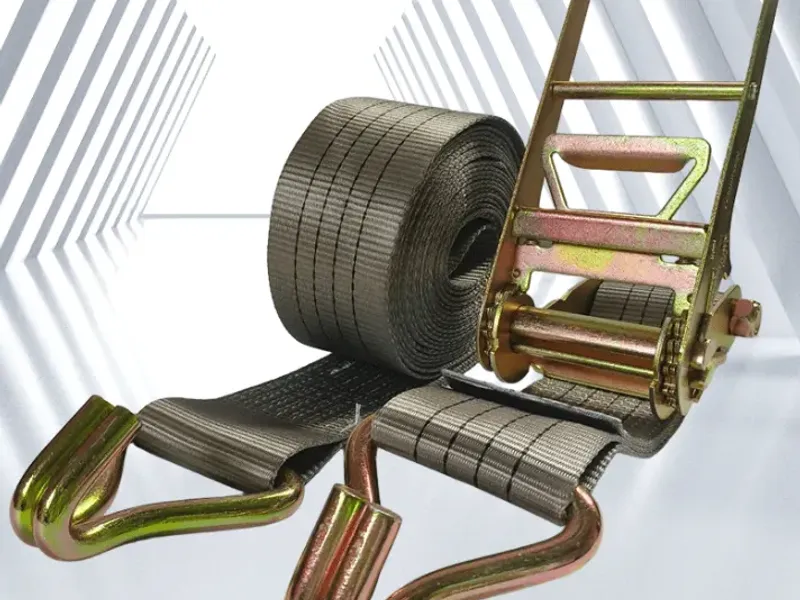
Standard Heavy Duty Ratchet Strap
Standard Heavy Duty Ratchet Strap with 2" polyester webbing and forged wire hooks, delivering a 10,000 lbs breaking strength and 3,333 lbs working load limit. Engineered for reliable cargo securement on flatbeds, trailers, and pickups, it offers corrosion-resistant hardware, low-stretch webbing, and a smooth-action ratchet for repeatable, safe tie-downs.
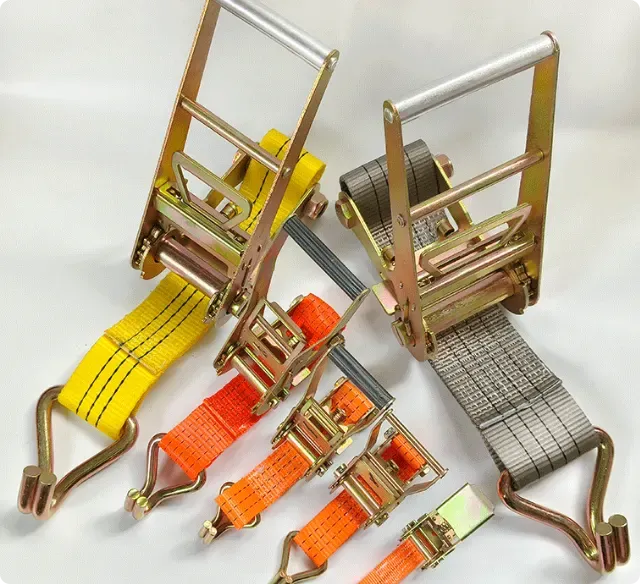
Heavy Duty Ratchet Buckle Assembly
Heavy Duty Ratchet Buckle Assembly engineered for 2-inch webbing, delivering a 3,335 lbs working load limit and 11,000 lbs breaking strength. Forged from zinc-plated, corrosion-resistant steel with an ergonomic wide-grip handle and double-locking pawl for secure, slip-free tensioning in demanding cargo control and transport applications.
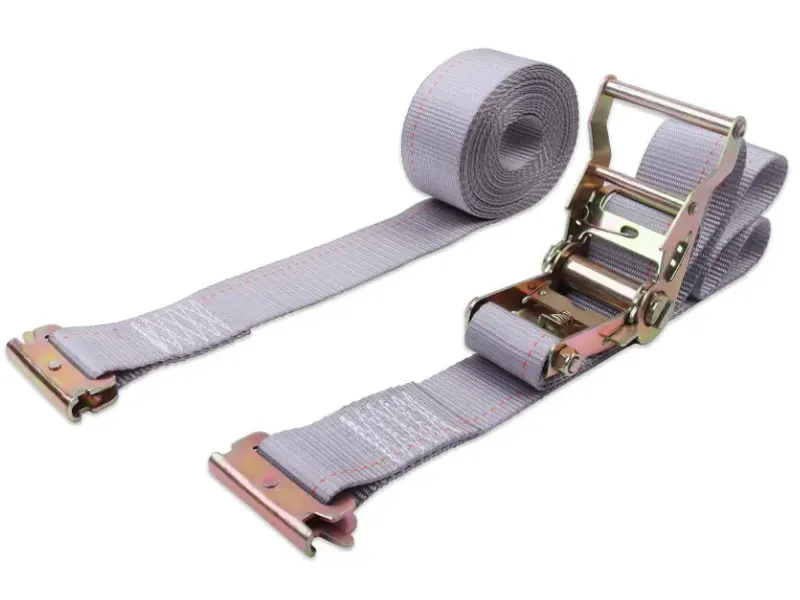
E-Track Ratchet Strap Assembly
Heavy-duty 2-inch E-Track ratchet strap assembly with spring-loaded E-fittings for fast, secure cargo lock-down in enclosed trailers, vans, and warehouses. Features abrasion-resistant polyester webbing, a corrosion-treated ratchet handle, and a 3:1 safety factor. Ideal for logistics fleets, moving companies, and OEM buyers requiring reliable, standards-compliant tie-down hardware.
Related Categories
Related Applications
Professional bulk storage practices to protect your ratchet strap inventory, extend service life, and maintain load-rating integrity
Request a Bulk Ratchet Strap Quote Today