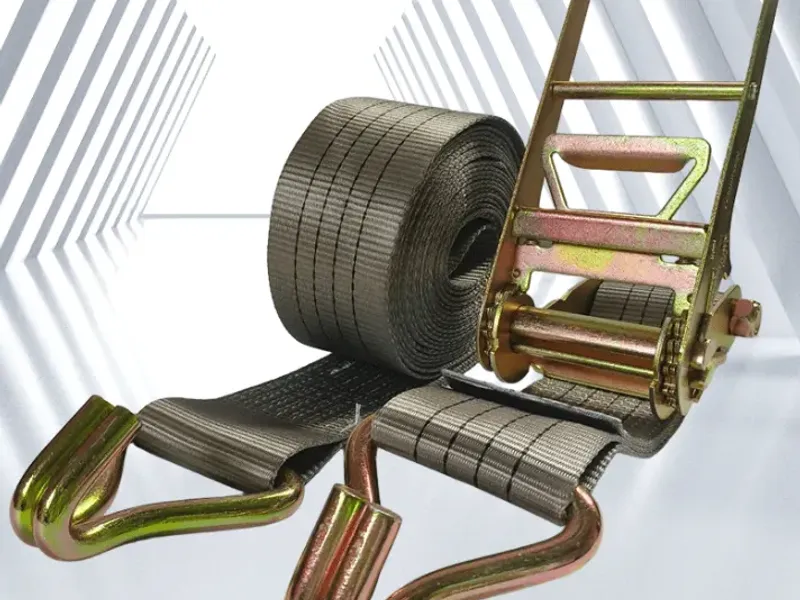
Solar panel shipments are vulnerable: a single scratch on a PV module's tempered glass can reduce efficiency by up to 5%. Standard cargo straps with abrasive hardware are responsible for 25% of in-transit damage. To meet on-time delivery with zero defects, logistics providers need a non-marking, soft-surface lashing system that combines high break strength with surface protection.
Critical Webbing Specifications for Solar Panel Securement
The width and material of tie‑down webbing directly influence glass integrity. Narrow straps concentrate force and can crack tempered surfaces, whereas wide polyester webbing distributes pressure evenly. For large‑format PV modules, we recommend our Double Eye Polyester Webbing in widths from 2 inches to 12 inches. A 4‑inch‑wide sling can offer a working load limit (WLL) up to 40,000 lbs, far exceeding the tensile demands of bundled panels. For operations that cut and assemble straps on‑site, the High‑Performance Industrial Webbing Roll provides 1‑inch to 4‑inch options in high‑density weave, meeting WSTDA and ISO 9001 standards. By contrast, using a standard 1‑inch utility strap is a common cause of stress fractures during threshold braking.
Corrosion‑Resistant Hardware for Open‑Air Transport
Solar panels are frequently moved on flatbed trailers exposed to rain, humidity, and road salt. Standard zinc‑plated ratchets and hooks often show rust within 6 months, compromising safe working loads. For logistics that span coastal or marine environments, the 316 Marine Grade Ratchet Strap is essential. Its 316 stainless steel hardware and UV‑resistant polyester webbing deliver a WLL between 1,600 lbs and 3,333 lbs, and it is saltwater‑safe per MIL‑Spec. Unlike conventional coated steel, marine‑grade components maintain full break strength after years of service, eliminating dangerous weak points.
Load Distribution with Multi‑Point Tie‑Down Systems
A single strap around a stack of modules cannot prevent lateral shift or twisting. Best practice is to use at least four independent tie‑downs anchored into an E‑Track system. Our E‑Track Ratchet Strap Assembly features a 360° swivel fitting that mates with E‑Track or T‑Track rails. Each assembly has a 1,600‑lb WLL in lift and 3,333‑lb WLL in drag, with a 48‑inch webbing length appropriate for standard pallet sizes. For repetitive routes, a Retractable Ratchet Strap System (12‑ft to 40‑ft) speeds up securement cycles and keeps excess webbing off the deck. The auto‑retract mechanism reduces trip hazards and prevents webbing fraying from dragging.
Precision Tensioning with Heavy‑Duty Ratchets
Solar modules require consistent, moderate tension—enough to prevent vibration but not so tight that frames distort. The Heavy Duty Ratchet Buckle Assembly handles webbing up to 3 inches wide and uses a double‑action pawl to prevent accidental release. Paired with our Standard Heavy Duty Ratchet Strap, the system yields a break strength of 10,000 lbs to 20,000 lbs and a WLL from 3,333 lbs to 6,667 lbs, depending on width. This ample margin allows operators to tighten to the recommended 400‑500 lbs of tension without approaching the strap’s yield point, providing a safety factor above 3:1.
End Fittings That Protect Glass Edges
Even a 2‑mm chip on a module’s edge can initiate a crack that propagates under thermal cycling, potentially lowering output by 5%. Selecting the right end fitting is as important as the webbing itself. Forged End Hooks (S/F/J/Hooks) are available in sizes from 1.5‑inch to 3‑inch webbing compatibility. Choosing safety hooks with a locking latch prevents accidental disengagement, while smooth, zinc‑plated finishes resist corrosion without adding sharp edges. For custom tie‑downs, Steel Eyelet End Fittings can be crimped or riveted to Double Eye Polyester Webbing, creating a high‑strength, non‑marring attachment point that eliminates metal‑on‑glass contact.