
The webbing is the heart of a cargo strap, but the hardware is its muscles. As a B2B buyer, you understand that a high-tensile 1000D webbing is useless if the buckle or hook snaps under tension. Hardware failure is the most common point of entry for safety incidents in the field.
This guide covers the metallurgy behind our components. We break down the differences between die-cast zinc, heat-treated carbon steel, and 316 stainless steel, and how to specify the right metal for your target market.
Understanding the Ratchet Mechanism (Mandrel & Pawl)
The mandrel (spindle) must be strong enough to wind the heavy webbing without bending. Meanwhile, the pawl must engage with the gear precisely. We use double-action pawls in our 2-inch and 3-inch straps to allow tensioning in both directions, significantly speeding up work for logistics crews.
Anatomy of a Heavy-Duty Ratchet Buckle Assembly
The heart of any ratchet strap is the buckle assembly. The Heavy Duty Ratchet Buckle Assembly is forged from heat-treated carbon steel and available in yellow, blue, or zinc-plated finishes for corrosion resistance. It accommodates webbing widths of 1.5, 2, and 3 inches, with a double-action interchangeable pawl mechanism that ensures consistent engagement under load. The assembly achieves a working load limit (WLL) of 3333 lbs for 1.5-inch webbing up to 6667 lbs for 3-inch webbing, with break strengths ranging from 10,000 to 20,000 lbs—a 3:1 safety factor that significantly exceeds typical cargo securement requirements.
Types of Forged End Hooks and Their Applications
End hooks transfer load from the webbing to the anchor point, and choosing the right style is critical. Forged End Hooks (S/F/J/Hooks) are manufactured from forged steel with zinc plating or yellow chromate finishes, sized for 1.5- to 3-inch webbing. S-hooks provide quick, tool-free attachment; J-hooks and flat hooks offer deeper throat openings for thicker anchor edges; and safety hooks incorporate a spring-loaded latch to prevent accidental disconnection. For example, a 2-inch webbing with a WLL of 4000 lbs will be fitted with a hook proof-tested to that same rating. While standard J-hooks allow rapid connections, safety hooks add a locking mechanism that reduces the risk of load shift in dynamic transport environments.
Auto-Retract Mandrels vs. Manual Wind Mandrels
The mandrel stores webbing when not in use, and two primary systems exist. Traditional manual mandrels require the operator to crank the handle to wind the strap, a process that can take over a minute per strap after each use. In contrast, the Retractable Ratchet Strap System employs a spring-loaded mandrel that automatically takes up slack, cutting stowage time by up to 75%. These auto-retract units come in lengths from 12 ft to 40 ft, mount via bolt-on or E-track compatible fittings, and are rated for 50,000+ cycles. While manual mandrels are often field-repairable, auto-retract systems provide superior speed and convenience for high-frequency operations.
Material Specifications: Carbon Steel vs. 316 Stainless Steel
Hardware material choice directly impacts service life and safety. Standard heavy-duty ratchet straps, like the Standard Heavy Duty Ratchet Strap, use carbon steel with zinc plating, achieving WLLs of 3333–6667 lbs and break strengths up to 20,000 lbs. For marine or corrosive environments, the 316 Marine Grade Ratchet Strap offers 316 stainless steel hardware with a WLL of 1600–3333 lbs. While 316 stainless has a lower WLL for the same webbing width compared to carbon steel, it withstands 1,000+ hours of salt spray testing versus only 72 hours for zinc plating, making it essential for saltwater exposure. This corrosion resistance eliminates frequent replacement, lowering total cost of ownership by up to 40% in coastal applications.
Related Resources
Related Products (3)
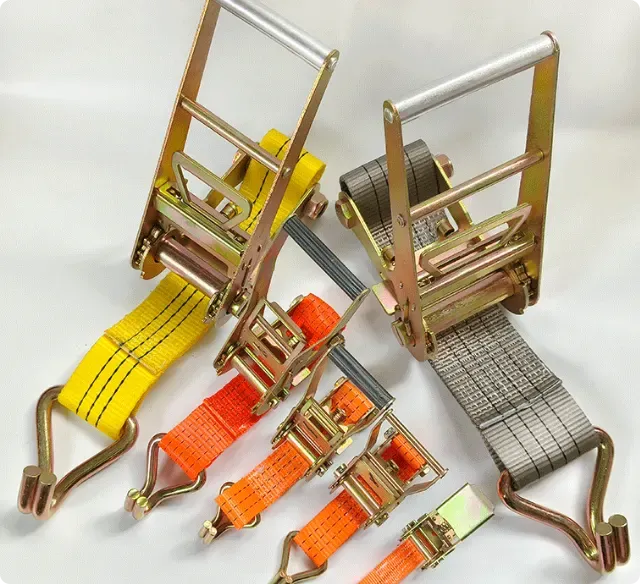
Heavy Duty Ratchet Buckle Assembly
Heavy Duty Ratchet Buckle Assembly engineered for 2-inch webbing, delivering a 3,335 lbs working load limit and 11,000 lbs breaking strength. Forged from zinc-plated, corrosion-resistant steel with an ergonomic wide-grip handle and double-locking pawl for secure, slip-free tensioning in demanding cargo control and transport applications.
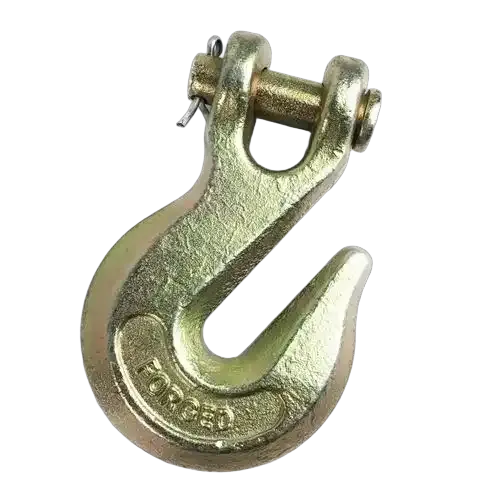
Forged End Hooks (S/F/J/Hooks)
TrustWebbing Forged End Hooks (S/F/J-Hooks) are drop-forged, heat-treated cargo control fittings engineered for 1"–4" tie-down and ratchet strap assemblies. Available as S-hooks, flat/snap hooks, and J-hooks with zinc or galvanized finishes, they deliver high breaking strength, corrosion resistance, and precise webbing-slot tolerances for OEM strap fabrication.
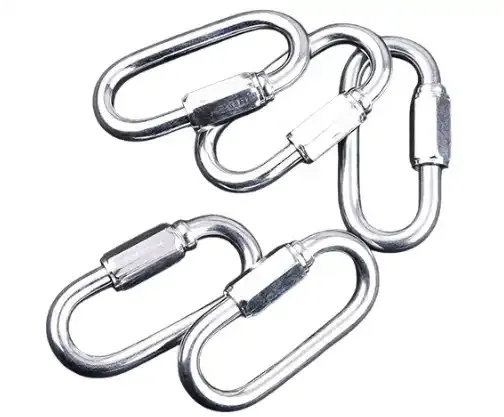
Steel Eyelet End Fittings
Heavy-duty forged steel eyelet end fittings engineered for lifting slings and webbing assemblies. Featuring a galvanized, corrosion-resistant finish and a precision-formed eye, these fittings deliver a 7:1 safety factor, high breaking strength, and reliable load transfer for industrial rigging, hoisting, and cargo securement applications.